FrenchBridge International Programmes
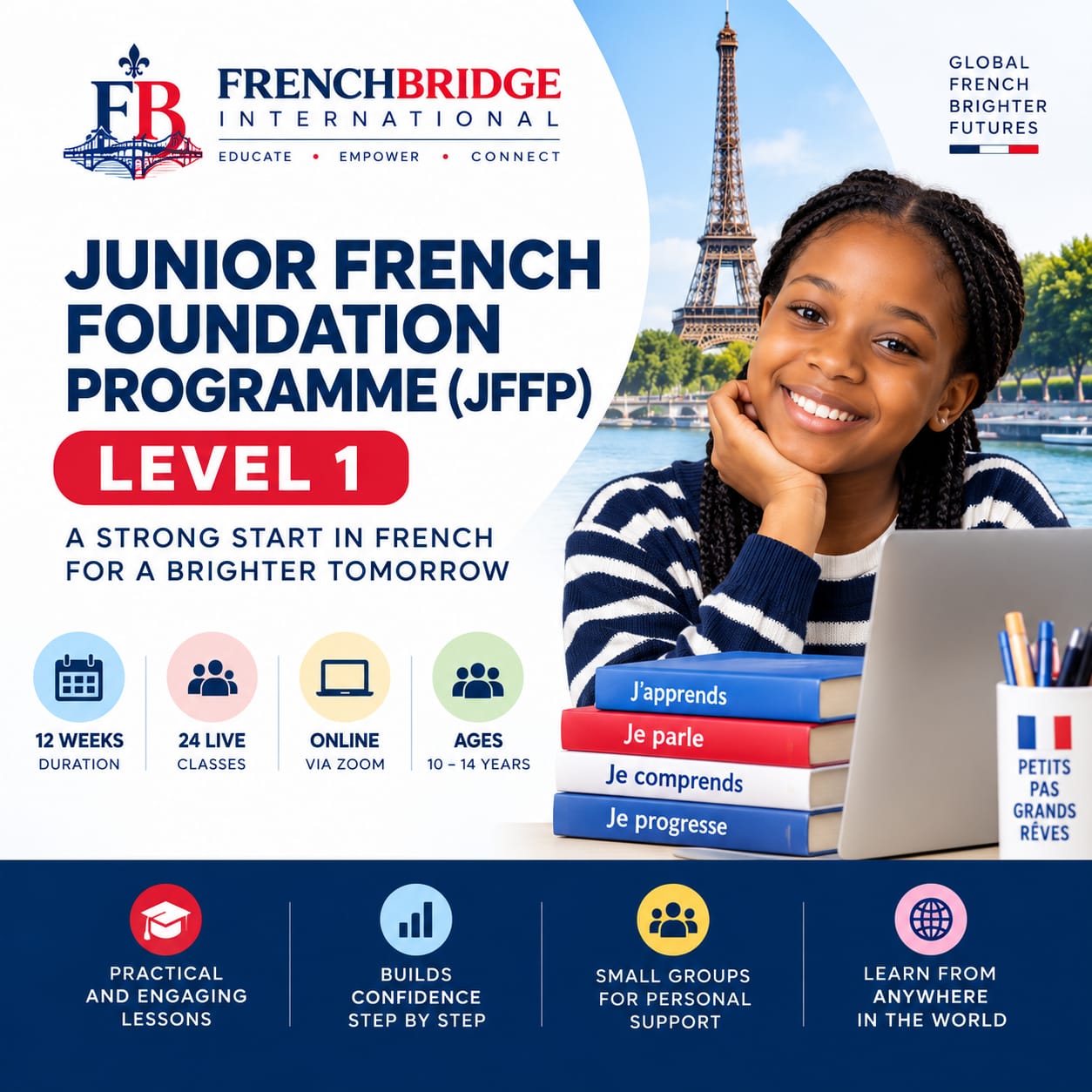
Junior French Foundation Programme (JFFP)
A strong French foundation for a more confident future.
A structured six-level live online French programme helping young learners aged 10–14 progressively develop the confidence to understand and use French.
- 12 Weeks Per Level
- 24 Live Interactive Classes
- Ages 10–14
- Online
Why JFFP?
Closing the gap between studying French and using it.
Many children study French for years but still struggle to use it independently. They may remember isolated vocabulary or classroom exercises, yet find it difficult to understand spoken French, pronounce words confidently, construct their own sentences, read unfamiliar language or hold a simple conversation.
JFFP was designed to close that gap. The programme develops French systematically, beginning with sound and language foundations and progressing toward increasingly independent communication across listening, speaking, reading and writing.
The central question is not simply, “Has this child studied French?” It is: “What can this child actually understand and do in French?”
Who Is JFFP For?
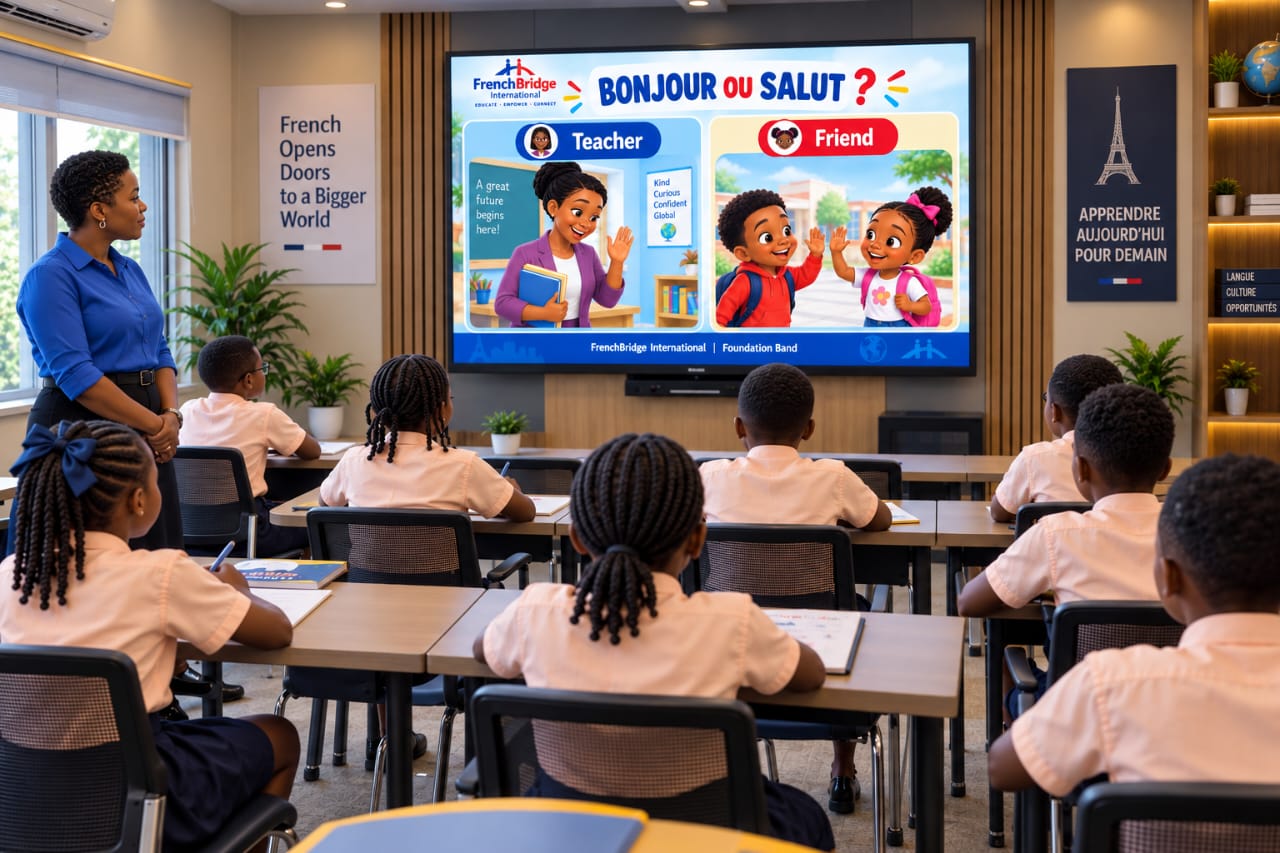
Designed for young learners aged 10–14.
- Complete beginners aged 10–14.
- Children who study French at school but have an insecure foundation.
- Learners who know vocabulary but struggle to construct sentences or communicate.
- Families seeking structured supplementary French learning.
- Internationally mobile and diaspora families who want children to develop practical French.
- Learners who need a strong foundation before more advanced or examination-oriented French study.
No prior French is required for Level 1. Learners with previous French experience may be placed at an appropriate point after assessment.
How the Programme Works
A clear, consistent structure.
- Age range
- 10–14 years
- Structure
- Six progressive levels
- Duration
- 12 weeks per level
- Live classes
- 24 classes per level
- Frequency
- 2 live classes weekly
- Class length
- 60 minutes
- Delivery
- Live online learning
- Skills
- Listening, speaking, reading and writing
- Assessment
- Continuous practice + end-of-level assessment
- Progression benchmark
- 70%
The Six-Level JFFP Pathway
Step by step, level by level.
- 1
Level 1
French Foundations
Builds the core language system: French sounds, pronunciation, greetings, introductions, numbers, classroom vocabulary, basic sentence construction, foundational grammar and simple questions.
- 2
Level 2
Everyday French
Develops practical everyday communication around family, home, school, food, hobbies, time, daily activities, preferences and high-frequency verbs.
- 3
Level 3
Building Communication
Moves learners into short connected conversations about routines, town, directions, transport, shopping, weather, health, invitations and plans.
- 4
Level 4
Independent Everyday French
Develops greater independence through travel, restaurants, technology, friendships, comparisons, opinions and introductory past-event narration.
- 5
Level 5
Developing Fluency
Strengthens accuracy, range and spontaneous communication through media, environment, healthy living, ambitions, culture, storytelling and multiple time frames.
- 6
Level 6
Confident Junior French
Consolidates junior French and prepares capable learners for more independent intermediate study through opinions, problem-solving, cultural comparison and communication across present, past and future contexts.

What Learners Develop
Real skills across all four areas.
- Pronunciation and sound-spelling awareness.
- Confidence in speaking and responding without relying only on memorised scripts.
- Listening comprehension for age-appropriate French.
- Vocabulary that can be used in meaningful contexts.
- Sentence-building and functional grammar.
- Reading for meaning, not merely word recognition.
- Structured writing that develops progressively across levels.
- Confidence using French in practical, familiar situations.
The FrenchBridge Learning Approach
Communication-first, with grammar as a tool.
JFFP is communication-first, but it does not ignore grammar. Grammar is taught as a tool that helps learners communicate accurately. New language is continually connected to previous learning so that learners retrieve, reuse and strengthen what they have already studied.
Standard lesson flow
- 1Retrieval
- 2Language Input
- 3Modelling
- 4Guided Practice
- 5Communication
- 6Reading/Writing Application
- 7Independent Check
- 8Home Practice
Home practice follows the same spiral principle. Worksheets do not isolate the newest topic; they deliberately revisit earlier sounds, vocabulary, structures and communication tasks so that learning is retained and interconnected.
Assessment & Progression
Progress measured across all four skills.
Learners are assessed across all four language skills, alongside continuous learning and participation.
Assessment weighting
- Continuous Learning & Participation20%
- Speaking25%
- Listening20%
- Reading15%
- Writing20%
Result bands
- 85–100%Highly Secure
- 70–84%Secure: Ready to Progress
- 60–69%Developing: Reinforcement Required
- Below 60%Foundation Not Yet Secure
The progression benchmark is 70%. A learner below the benchmark does not automatically repeat the entire level. FrenchBridge identifies the specific gaps and may prescribe targeted reinforcement before progression.
CEFR Positioning
The JFFP pathway is CEFR-aligned in its broad direction, but completion of a FrenchBridge level does not automatically confer an official CEFR level. Proficiency is demonstrated through assessment. Level 6 prepares strong learners toward more independent intermediate and B1-oriented work rather than guaranteeing B1 attainment.
JFFP certificates are FrenchBridge programme certificates and are not DELF, official CEFR or government qualifications.
Learner Resources
Everything learners need to practise.
- Branded lesson presentations and visual learning materials.
- Practice sheets and cumulative home-practice worksheets.
- Pronunciation and sound activities.
- Vocabulary, reading and writing tasks.
- Interactive speaking and communication activities.
- Quizzes and end-of-level assessments.
- Supplementary digital resources where appropriate.
Parent Journey
From discovery to the next level.
- Step 1
Programme Discovery
- Step 2
Registration/Payment
- Step 3
Parent & Learner Onboarding
- Step 4
Welcome Communication
- Step 5
Class Access
- Step 6
12-Week Programme
- Step 7
Assessment
- Step 8
Progression Decision
- Step 9
Certificate
- Step 10
Next-Level Enrolment
Class access is provided privately after registration and onboarding.
Certificate
Learners who complete a level receive a FrenchBridge Junior French Foundation Programme Certificate of Completion identifying the specific FrenchBridge level completed. Level 6 also culminates in the FrenchBridge Junior Programme Exit Assessment.
Parent FAQs
Give your child more than French exposure. Give them a structured pathway to understand it, use it and grow in confidence.
Join the next JFFP cohort and begin with the level that matches your child's current foundation.
A strong French foundation for a more confident future.
Speak with the FrenchBridge International team to find the right starting level for your child.